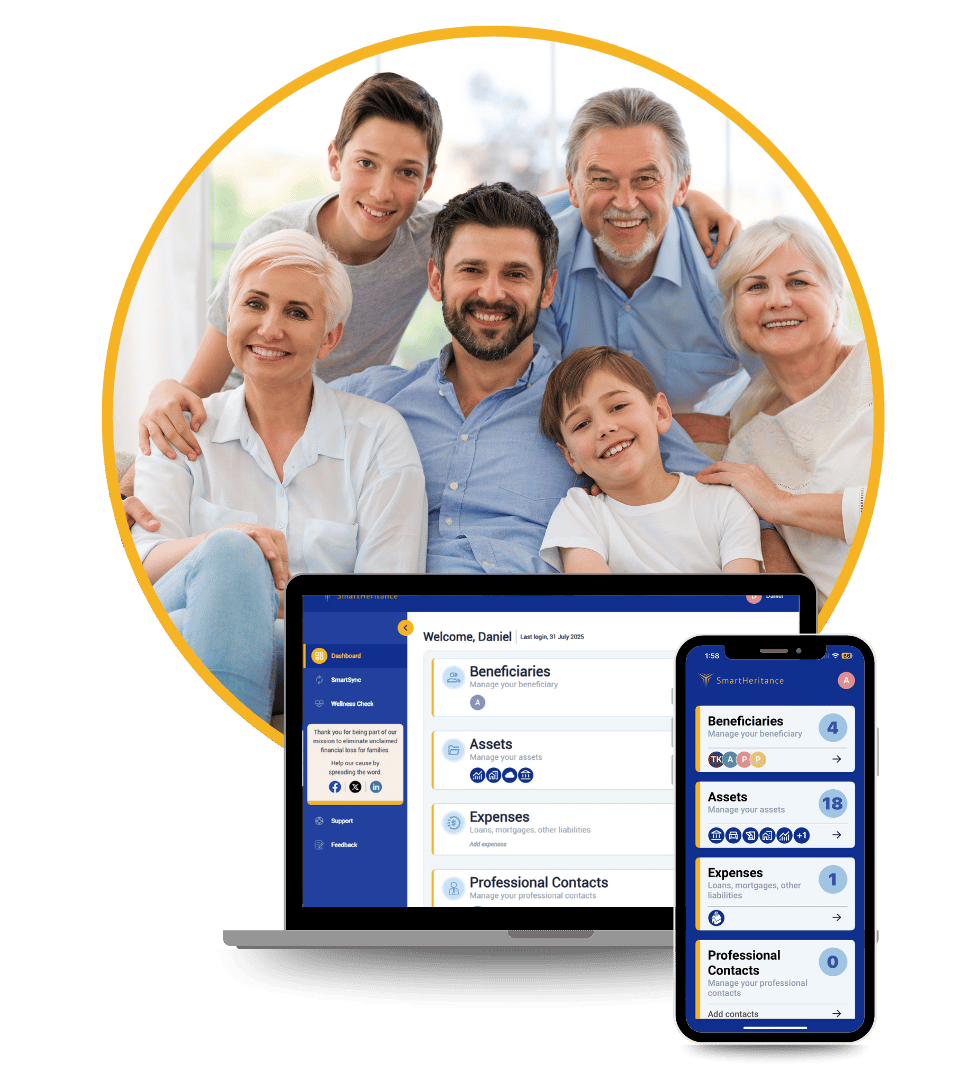
The plan is signed once. The estate keeps changing.
A will and a trust are static instruments. The accounts, deeds and digital holdings they govern are not. SmartHeritance gives estate planning attorneys and trust professionals a living record of what the client actually owns, and tells you when it changes.
The document is durable. The schedule of assets is not.
A plan is drafted against a snapshot of a client’s holdings. From the day it is executed, that snapshot begins to age, and nothing in the file knows it.
A Plan, Five Years On
In the file
The assets scheduled on the day of execution
Acquired since
Never funded
The trust exists. The assets were never retitled into it
Nothing tells you the estate has moved.
The client buys a property, opens an account or acquires digital holdings. No trigger reaches your office. The next you hear of it is at a review years later, or not at all.
Drift is invisible until it becomes a problem for the family
The executor inherits a search, not a schedule.
Administration begins with reconstruction: chasing statements, tracing accounts, guessing at what existed. Probate lengthens for reasons that have nothing to do with the drafting.
$77B+ in unclaimed assets in the US: a documentation failure, not an absence of wealth
The engagement ends at signature.
A flat fee, a binder, and a client who disappears for a decade. The most valuable service a planner can offer, keeping the plan true, has no delivery mechanism and no billing model.
A transactional practice cannot compound
A plan that no longer describes the estate is not a plan. It is a document about a life the client used to have.
$124T
Passes between generations in the US through 2048. Every estate of it will be administered against whatever records exist.
~2 in 3
US adults have no will or estate plan at all. The profession's constraint is engagement, not demand.
$77B+
Sits in unclaimed property held by US states: assets that had owners, and heirs, and no record connecting the two.
Sources: Cerulli Associates; Caring.com Wills and Estate Planning Survey; state unclaimed property administrators.
Four steps. No practice management integration at any of them.
The platform does the collecting and the maintaining. Your practice sends one link and reads what the client chooses to share.
Clients are invited through a branded link
At the signing meeting, or in the follow-up letter. We provision a link carrying your firm's name; the client verifies by OTP. Nothing touches your document management system.
Practice effort: one email at engagement close

The vault collects and structures what exists
Accounts, deeds, policies, business interests, digital holdings and instructions are located and organised into the working schedule of assets your drafting depends on. SmartSync maintains it as circumstances change.
Nothing is drafted. Everything is located and organised
Material changes surface to you
A property purchase, a new account, a business interest, a beneficiary revision. Each is a documented reason to reopen the plan, where the client has granted visibility and only while they maintain it.
Amendments prompted by events, not by the calendar

The executor begins with a schedule, not a search
When the client's predefined conditions are verified, the named executor and beneficiaries receive a current, organised record of the estate, with your firm's details alongside it.
The administration step, resolved years in advance


What changes about your practice.
A one-time engagement becomes an ongoing one
Every material change in a client's holdings is a documented, defensible reason to reopen the plan. The maintenance conversation finally has a trigger.
Recurring revenue from clients you already have
You draft against a real schedule of assets
Intake stops depending on what a client remembers in a meeting. Unfunded trusts, missed accounts and untitled property surface while they can still be corrected.
Better instruments, fewer omissions
Fewer disputes, shorter administration
Accurate, current records remove the ambiguity that turns an estate into a family argument, and they remove the reconstruction work that inflates every probate timeline.
Less time tracing assets, more time advising
The next generation is a client, not a stranger
Executors and beneficiaries are named and reachable during the client's lifetime. When administration begins, your firm is already the known counsel rather than a name in a binder.
Instructions that carry into the next generation
A modern offer beside a traditional one
Digital assets, cross-border holdings and access records are where most plans are now weakest. Covering them distinguishes a practice from every firm still issuing a printed binder.
Differentiation on the gap clients feel
Nothing to build and nothing to unwind
No integration, no data migration, no change to how you draft or bill. A pilot requires a link and a covering note, not a technology decision.
Assessable within one engagement cycle
Two ways the same client relationship can run.
The difference is not the quality of the drafting. It is whether anything connects your practice to the client between the signature and the estate.
SmartHeritance supplies that connection, and with it a service you can legitimately charge for year after year.
Today · Transactional
One fee. A decade of drift. An administration that begins with reconstruction.
With SmartHeritance · Maintained
Every acquisition is a touchpoint. The executor opens a current schedule, and your firm is already in it.
A digital asset vault that aggregates what already exists.
SmartHeritance does not draft instruments, give legal advice or act as a fiduciary. It locates the records a household already holds, structures them, and keeps them current, so the schedule your drafting depends on stays true between engagements and remains legible to you where the client permits it.

Titled property and accounts
- Real property and deeds
- Bank and brokerage accounts
- Retirement plans and beneficiaries
- Business interests and holdings
Reveals unfunded trusts and untitled assets
Instruments and cover
- Existing wills and trusts
- Powers of attorney and directives
- Life and disability policies
- Carrier, counsel and fiduciary contacts
Surfaces conflicting or superseded documents
Digital holdings
- Digital currency positions
- Online financial accounts
- Recurring obligations
- Access and recovery records
Covers the weakest part of most plans
People and intent
- Executors, trustees and guardians
- Beneficiaries and release conditions
- Existing advisors and accountants
- Final instructions
Introduces you to the next generation
Begin with a defined pilot, not a procurement cycle.
A single cohort of clients, a fixed period, and measurement on adoption and record completeness. Nothing to integrate and nothing to unwind if the practice decides against it.
The first cohort is offered at no cost to the practice. Commercial terms are scoped once the pilot data is reviewed.
No integration with practice management or document systems
No instruments drafted, no legal advice given, no fiduciary role taken by us
Visibility granted by the client, revocable by the client
White-label options for firms, trust companies and fiduciary practices
Compliance documentation provided on request
Select the pilot cohort
Twenty to fifty clients, typically recent signings or the files you know are most out of date.
We provision and brand the link
Your firm's name on the invitation. We supply the covering letter and the client-facing explainer.
Clients onboard themselves
OTP verification and guided setup. No fee-earner time is required beyond sending the invitation.
We review the results together
Enrolment, record completeness and the amendments the pilot surfaced. The practice decides what follows.
The client owns the record. Always.
What a client records is deeply personal, and often privileged in substance. Access is granted by the client. It is never assumed by a firm, and never available to our own team.
Bank-Grade Encryption
AES-256 at rest and in transit, the standard applied by major financial institutions.
SOC 2 Type II Certified
Independently audited for security, availability and data integrity. Documentation on request.
Zero-Knowledge Architecture
No SmartHeritance employee can read a client record. Privacy is structural, not procedural.
Condition-Based Release
Records reach an executor only once the client's predefined conditions are verified.
For risk and compliance partners: SmartHeritance is a client-owned record, not a law practice, a system of record for your firm, or a substitute for any instrument. We do not draft documents, give legal advice or act as executor, trustee or fiduciary. Firm visibility exists only where a client explicitly grants it.
Request Compliance DocumentationKeep the plan true after the client leaves your office.
SmartHeritance works with solo practitioners, estate planning boutiques, full-service firms, trust companies and fiduciary practices. Describe how your practice is structured and we will scope the appropriate pilot.
Firm-sponsored, client-paid and revenue-share models available
Runs alongside your existing technology, not through it
Deploys in days, outside any engagement calendar
Request a pilot
We will walk you through the client experience, the firm view, and how the pilot is measured.