

TL;DR
- Insurance customer engagement is built around two moments: the sale and the claim. The policy lifecycle between them, spanning 20 to 40 years, gets almost no attention.
- During that window, beneficiary designations go stale, financial records grow outdated, and families lose the operational context needed to act on the policies they paid for.
- Portals, password managers, and digital vaults do not solve this. They each address a narrow slice while the core gap remains untouched.
- SmartHeritance fills that gap with an operational continuity layer that keeps records current automatically and ensures information reaches the right family members at the right time through a verified process.
Customer engagement in insurance is largely built around two moments:
- Getting a customer to buy,
- and processing their claim efficiently.
Both matter. But the relationship between those two events can span 20 to 40 years, and during that entire period, almost nothing is done to maintain the operational connection between the policy and the family it was intended to protect.
The result shows up not in insurer dashboards, but in family experiences. A surviving spouse who spends weeks trying to locate a policy. An adult child who discovers a parent had accounts and coverage they knew nothing about. A beneficiary designation that reflects a marriage that ended fifteen years ago. These are not edge cases. They are the default outcome of an engagement architecture that was never designed to maintain family readiness across the full policy lifecycle.
This article examines where that architecture breaks down, why the tools most carriers already rely on cannot fix it, and what building genuine long-term value in insurance customer engagement actually requires.
Why Insurance Customer Engagement Breaks Down After Policy Purchase
The first step in improving insurance customer engagement is understanding where investment is concentrated, because the pattern reveals exactly where the gap sits.
At the Sale: Strong Processes, Clear Metrics
Lead generation, digital underwriting, simplified onboarding, welcome communications, and agent enablement tools all orient toward a single outcome: getting a customer to commit to a policy and onboard cleanly. That investment is justified because conversion rates and time-to-bind are visible, measurable outcomes that directly affect revenue.
At the Claim: Significant Investment Over the Past Decade
Digital first notice of loss, AI-assisted adjudication, claim status transparency, and improved beneficiary communication have all reduced friction and improved the experience at the moment families most need the product to work. Carriers have rightly prioritized this investment.
Between Sale and Claim: Almost No Engagement Infrastructure Exists
Between issuance and claim, insurance customer engagement varies considerably. Most carriers offer renewal reminders, annual statements, and occasionally a mobile app with a coverage summary. Some maintain agent outreach if the book is actively managed, but that coverage is inconsistent and diminishes as agent relationships turn over.
None of these mechanisms maintain what actually matters for long-term value: the family’s operational ability to act on the policy when the time comes. No existing touchpoint ensures that beneficiary designations reflect current reality. None verify that the policyholder’s family has working knowledge of what exists. None create a living record of the policyholder’s broader financial life that families can navigate under pressure. The purchase moment and the claim moment are both well-resourced. The long middle is not, and the consequences of that gap are concrete and measurable.
Why Policies Become Inaccessible Between the Sale and the Claim
Weak insurance customer engagement during the policy lifecycle does not just produce a poor customer experience. It produces specific operational failures that directly affect whether a family can act on a policy at all.
Beneficiary Information Becomes Outdated
A policyholder names a beneficiary at issuance, and that designation reflects their life at that moment: a spouse, a sibling, a parent. Then life continues. Marriages end, children are born, relationships change, and remarriages happen, but the designation often does not change with them.
Carriers have made beneficiary updates easier through online portals, mobile apps, and agent-assisted changes, and the capability genuinely exists. The problem is that the behavior does not reliably follow, because the life events that should trigger an update, a divorce, a death, a remarriage, are exactly the moments when updating an insurance form is furthest from a family’s mind. A capability to update is not the same as a system that ensures designations stay current, and the evidence of this failure shows up in the volume of contested beneficiary designations that carriers manage at claims time.
Financial Records Change Over Time
At issuance, the insurer captures a snapshot of the policyholder’s financial life. That snapshot grows increasingly inaccurate from the moment it is taken, because the policyholder’s financial complexity continues to grow throughout the policy term.
According to a 2024 NordPass study, the average person manages around 168 passwords across personal accounts, and each one represents a separate digital relationship with a bank, a brokerage, an insurance portal, a retirement platform, a cloud service, or a subscription. Most of those accounts were opened after the original policy was issued, none of them are visible to the insurer, and none are organized in a way the policyholder’s family can navigate under pressure. When something happens to the policyholder, their family is not just managing a life insurance claim. They are attempting to reconstruct an entire financial life they were never shown, one that has grown substantially more complex since any documentation was last current.
Families Often Do Not Know Policies Exist
For a family to act on a policy, they first have to know it exists, and that knowledge cannot be assumed. The NAIC’s life insurance policy locator service illustrates exactly how widespread this failure is. As reported by CNBC Select in April 2026, the NAIC’s locator tool has helped recover more than $13 billion in benefits since its launch in 2016. That figure is not a ceiling on what was at risk. It is a floor, because it only counts benefits that families eventually found their way to recover. It does not include benefits that expired quietly, claims that were never initiated, or families who assumed there was nothing to find. This outcome is a direct consequence of an engagement architecture that ends at issuance and expects families to arrive at the claim already equipped with information they were never given.
The Hidden Cost of Poor Post-Purchase Engagement
When customer engagement in insurance does not extend across the full policy lifecycle, the operational drift that accumulates during the long middle creates specific, recognizable costs at claims time.
Claims Take Longer When Families Lack Information
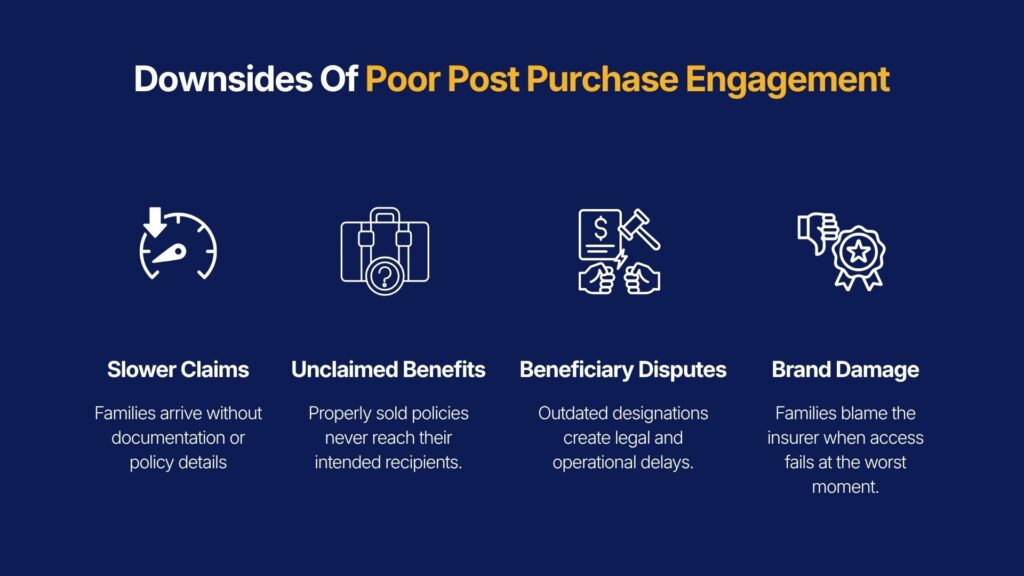
Insurer claims processes have improved substantially over the past decade, but those processes are optimized for families who arrive equipped with the policy number, the carrier’s name, the documentation, and a basic understanding of what they are entitled to. When families arrive without those things, which happens far more often than claims data reflects, the process extends significantly. The friction is on the family’s side, but the experience damage lands on the carrier’s brand.
Life Insurance Benefits Go Unclaimed
The $13 billion NAIC recovery figure makes the scale of the problem concrete, but the more important observation is what that number actually represents. Those were benefits that were properly sold, properly priced, and properly structured, and they still did not reach the families they were written for because no mechanism existed across the policy lifecycle to ensure the family knew where to look.
Outdated Beneficiaries Create Disputes
Outdated beneficiary designations generate legal and operational complexity that carriers manage routinely across their books of business. A surviving spouse who is not the named beneficiary, a designated beneficiary who has predeceased the policyholder, a designation that reflects a prior marriage: each of these is a claims complication with meaningful legal dimensions, and each traces back to the same root cause. The designation system captures intent at issuance but has no mechanism to reflect life as it actually unfolds across a 20 to 30 year policy term.
Families Blame the Insurer When Access Problems Occur
A family that struggles to locate and access a benefit does not typically attribute that struggle to the structural gap in the policy lifecycle. They attribute it to the insurer, and from their perspective, the product failed them when they needed it most. In a market where group life and term policies are increasingly commoditized and customer loyalty is driven primarily by experience, the post-purchase brand relationship is one of the few remaining differentiation surfaces available to carriers. The long middle is where that relationship is either built or permanently damaged, and most carriers are not actively managing it.
Why Existing Insurance and Estate Planning Tools Fall Short
When the insurance customer engagement gap comes up in carrier discussions, several existing tools are typically assumed to address it. A closer look at each reveals why they fall short.
Insurance Portals Only Help Families Who Already Know the Policy Exists
Digital portals improve the claims initiation experience for families who already know a policy exists, know the carrier’s name, and arrive with enough information to start a process. They do not help the family that does not know the policy exists in the first place. A portal requires the family to arrive already equipped, which means the gap the portal was meant to solve exists entirely upstream of where the portal operates.
Insurance Portals Only Help Families Who Already Know the Policy Exists
Password managers store account credentials, but they do not capture the operational inventory of financial commitments, insurance policies, retirement accounts, property records, digital assets, and ongoing obligations that a family needs to manage a household after a death or incapacity. Sharing a password to a banking portal is meaningfully different from transferring an understanding of how a household’s entire financial life is structured. The scope mismatch between what a password manager delivers and what a family actually needs is categorical.
Estate Attorneys Cannot Help Families Find Missing Policies and Accounts
An estate attorney distributes what is already known, legally documented, and organized. A will does not tell anyone where an insurance policy is filed, and an estate attorney is not monitoring account changes or ensuring the right information reaches the right people through a verified process at the right time. By the time an estate attorney is involved in administering an estate, the discovery work that determines whether a family can act on a policy has either already been done by someone or has already failed.
Digital Vaults Are Only as Complete as What Users Upload
Digital vaults store what a user manually uploads, but they do not discover what exists, do not verify whether records are current, and do not proactively release information through a verified process when a qualifying event occurs. They are storage systems, not continuity systems. A vault populated with everything is genuinely useful. A vault that contains what the user remembered to add, organized once three years ago and never updated, reflects exactly the same discipline gap that causes the insurance engagement problem in the first place.
What Genuine Post-Purchase Engagement Requires
Genuine long-term value in insurance customer engagement is not a better app or a more frequent touchpoint. It is a structural answer to two specific problems that no existing tool addresses: the stale-record problem and the activation problem.
SmartSync: Keeping Policy Records Current Without Manual Effort
The stale-record problem exists because a policyholder’s financial life changes faster than any manual documentation system can follow across a multi-decade policy term. New accounts are opened, old accounts are forgotten, policies are purchased and then misplaced, and retirement funds accumulate across different institutions as employment changes over the years.
SmartHeritance’s SmartSync addresses this at its source. By connecting to a user’s existing email account, SmartSync scans for correspondence from financial institutions, insurance providers, retirement platforms, brokerages, and digital services, identifies accounts that have generated an email trail, extracts the relevant information, organizes it into structured categories, and presents it to the user for review before anything is stored. After the initial scan, SmartSync continues running periodic scans and automatically identifies new accounts as they are opened, adding them to the continuity record without requiring any manual action from the policyholder. Every financial account a person has ever opened has generated an email trail, and SmartSync turns that existing trail into an organized, current record that families can actually use.
Wellness Check Protocol: Getting Information to the Right People at the Right Time
The activation problem is distinct. Even when information is organized and current, it has no value if no mechanism exists to deliver it to the right people at the right moment through a verified process, and this is precisely where most digital systems fail.
Most digital platforms are passive. They store information and wait for someone to arrive with the right credentials, which means they fail in exactly the scenario where they matter most: when the policyholder is no longer able to direct their own access. SmartHeritance’s Wellness Check Protocol works differently. Rather than waiting for a family to find the platform, it monitors for inactivity and checks in with the user directly when inactivity reaches a threshold. If the user does not respond, the platform reaches out to designated family members. If those family members confirm a qualifying event has occurred and provide the required verification, the platform releases the stored information to the designated recipients in the way the policyholder set up in advance. No family member has to remember the platform exists, and no one has to search under the pressure of grief.
How SmartHeritance Fits Into the Insurance Customer Journey
SmartHeritance is not a claims tool, a policyholder portal, or a competing digital infrastructure layer. It is the operational continuity layer between policy issuance and family readiness: the infrastructure that sits across the full long middle of the policy lifecycle and determines whether the insurer’s promise is actually deliverable to the family it was written for.
How Insurers Can Create Value Long After Policy Purchase
Carriers that address the insurance customer engagement gap are not simply solving an operational inconvenience. They are building a differentiation position that their competitors have not yet established.
Prepared Families Produce Faster, Cleaner Claims
When families arrive at a claim already knowing the policy exists, knowing the carrier, and having access to the relevant documentation, claims initiate faster, adjudication is more efficient, and the family’s experience of the brand at its most consequential moment is fundamentally different. This is not a soft benefit. It is a measurable improvement in the operational efficiency of the claims function and in the brand relationship that determines whether a family’s next life insurance decision returns to the same carrier.
Family Readiness Is a Differentiation Lever No Carrier Has Used at Scale
Product differentiation at the coverage level, whether through term length, rider structure, or underwriting flexibility, is increasingly difficult in a market where most policies are functionally similar and pricing pressure is constant. The post-purchase engagement experience is an underutilized competitive surface, and offering family operational readiness as a benefit embedded in a life insurance policy is a differentiation play that has not yet been made at scale. The carrier that builds this first is not just offering coverage. They are offering the completion of the promise that coverage was always intended to deliver.
SmartHeritance can be offered as a value-added benefit alongside life insurance policies without requiring complex integrations or product redesign. The deployment model is straightforward: provide policyholders with access, connect the benefit to the policy relationship, and extend the carrier’s engagement into the long middle of the policy lifecycle in a way that creates genuine, ongoing value for the family.
Closing the Gap Reduces Legal, Operational, and Brand Exposure
When the insurance customer engagement gap goes unaddressed, carriers absorb operational liabilities at claims time that could have been avoided: undiscovered policies, contested beneficiary designations, families arriving at claims without the documentation they need, and the brand damage that follows when a product meant to protect a family fails to do so operationally. Addressing the gap proactively through a platform that keeps records current and ensures families receive what they need through a verified process reduces those liabilities before they reach the claims stage, before the family is in crisis, and before the brand relationship has already been compromised.
Conclusion
Every carrier selling life insurance is implicitly making a two-part promise: financial protection if something happens, and a clear path forward for the family when it does. The financial side of that promise is fulfilled when the claim is paid. The operational side, ensuring families know what exists, can find it, and can act on it, has not been addressed at scale by insurance customer engagement strategies.
SmartHeritance is built to close that gap. If your post-purchase engagement strategy ends at the welcome email and resumes at the first notice of loss, the operational layer that connects those two moments is what SmartHeritance provides.
To explore how SmartHeritance integrates with life insurance carrier programs, visit www.smartheritance.com or reach out at info@smartheritance.com .
References
- NAIC, Life Insurance Policy Locator Tool Helps Consumers Connect with More Than $13 Billion in Benefits, September 2025. https://content.naic.org/article/naic-life-insurance-policy-locator-tool-helps-consumers-connect-more-13-billion-benefits
- CNBC Select, Over $13 Billion Has Already Been Recovered from Unclaimed Life Insurance Policies, April 2026. https://www.cnbc.com/select/how-to-find-unclaimed-life-insurance-policy/
- NordPass, How Many Passwords Does the Average Person Have?, 2024. https://nordpass.com/blog/how-many-passwords-does-average-person-have/
- LIMRA & Life Happens, U.S. Life Insurance Need Gap Grows in 2024, April 2024. https://www.limra.com/en/newsroom/news-releases/2024/u.s.-life-insurance-need-gap-grows-in-2024/
- MetLife, Economic Concerns Lower U.S. Workforce Health and Productivity, 2025 Employee Benefit Trends Study, March 2025. https://www.metlife.com/about-us/newsroom/2025/march/economic-concerns-lower-us-workforce-health-and-productivity-raising-need-for-employee-employer-trust-new-metlife-study/
- Propello Cloud, Customer Engagement in Insurance: How to Stop Churn Before It Starts, 2025. https://blog.propellocloud.com/customer-engagement-in-insurance