




TL;DR
- Financial wellness benefits for employees typically cover budgeting, emergency savings, debt coaching, student loan repayment, and retirement planning.
- These programs help employees build financial security during their working lives. None of them ensure that a family can actually find, access, and use that security after an employee dies or becomes incapacitated.
- The gap shows up across every financial benefit layer: HSAs a surviving spouse never knew existed, retirement accounts from previous employers that go unclaimed, life insurance beneficiary forms completed at hire and never updated.
- This missing layer is called family continuity planning, and it is the one financial wellness benefit almost no company currently offers.
- HR leaders should add one question to their financial wellness benefits audit: when something happens to an employee, will their family know where everything is?
Financial wellness benefits for employees have become one of the fastest-growing categories in the modern benefits package. Employers now offer budgeting tools, emergency savings accounts, student loan repayment, one-on-one financial coaching, and retirement planning access. According to Paychex, financial wellness is now considered a foundational benefit in 2026, driven by the reality that financial stress is one of the leading causes of employee burnout and disengagement.
The programs are genuinely useful. They help employees reduce debt, build emergency funds, and plan for retirement. That is real and measurable value.
But there is a version of financial wellness that none of these programs address. It is not about building wealth during a career. It is about whether the wealth being built is actually accessible to the people it was meant for after the employee is gone.
When one of your employees dies this year, will their family know which financial accounts exist? Will they know which institution holds the retirement fund, where the life insurance policy is stored, or whether the HSA balance was ever communicated to anyone? Will they be able to act on any of it without spending months in administrative chaos during the worst weeks of their lives?
That is the financial wellness gap this article is about. And it runs through every layer of the programs most employers currently offer.
What Financial Wellness Benefits for Employees Actually Cover
Financial wellness is now a defined and well-researched benefit category. According to Nixon Peabody’s 2025 analysis of employer financial wellness programs, the core components include financial education and literacy resources, one-on-one coaching with certified financial planners, budgeting and debt management tools, emergency savings support, and retirement planning guidance that goes beyond auto-enrollment.
In practice, this translates to programs that help employees with the following areas.
- Budgeting and debt management: Tools and coaching that help employees track spending, reduce high-interest debt, and build toward specific financial goals.
- Emergency savings: Employer-sponsored emergency savings accounts, often with matching contributions, that give employees a buffer for unexpected expenses. According to a 2025 U.S. Chamber of Commerce report, 42% of Americans do not have an emergency fund, making this one of the most impactful financial wellness benefits employers can offer.
- Student loan repayment: Employer contributions toward employee student loan balances, one of the fastest-growing financial wellness benefits as of 2026, particularly among younger workforces carrying significant education debt.
- Retirement planning access: Guidance beyond 401k enrollment, including access to certified financial planners, retirement calculators, and education on investment options within the plan.
- Financial coaching: One-on-one access to financial advisors who can help employees with personalized plans for debt reduction, savings goals, home purchases, and long-term wealth building.
- HSA and FSA optimization: Education on how to use health savings accounts and flexible spending accounts to their maximum advantage as part of a broader financial plan.
These programs represent a genuine step forward in how employers think about employee financial wellbeing. Research from PwC found that employees who are not stressed about their finances are five times less likely to be looking for a new job, which means the business case for financial wellness investment is strong and well-documented.
But read through the list above carefully. Every component addresses the employee’s relationship with money during their working life. None of it addresses what happens to that money, and whether their family can reach it, when the employee is no longer there.
The 7 Financial Benefit Layers and Where Each One Stops
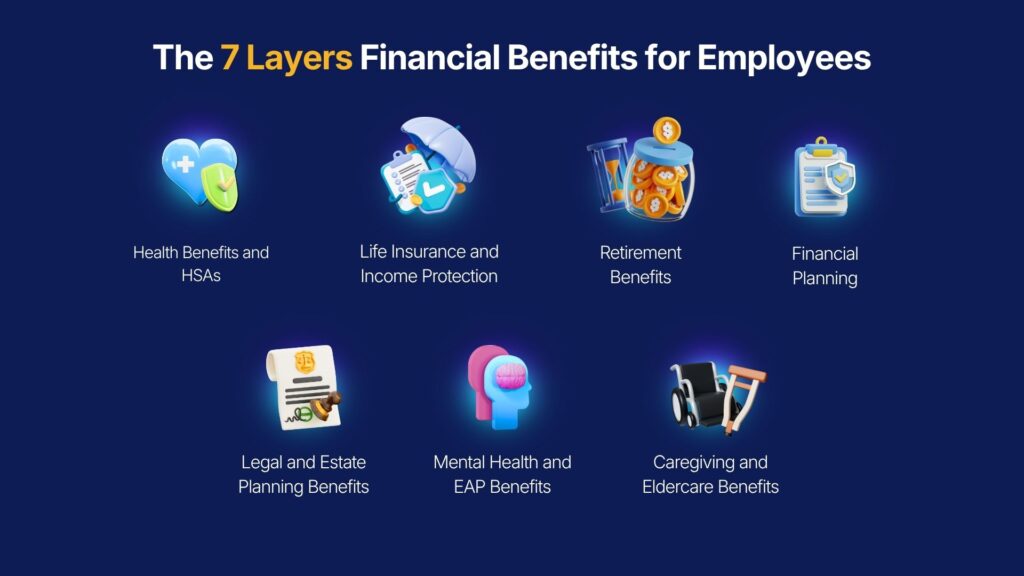
Understanding the gap requires looking at each financial benefit layer specifically, because the problem is not a single oversight. It is the same structural failure appearing in every layer, consistently, across every benefits package.
Layer 1: Health Benefits and HSAs
Medical, dental, vision, and health savings accounts represent the largest single cost center in most employee benefits packages. According to KFF’s 2025 Employer Health Benefits Survey, the average annual family health premium reached $26,993, covering roughly 154 million non-elderly Americans through employer-sponsored plans.
HSAs sit at the intersection of financial wellness and health coverage. Employees fund them through payroll deductions, often across years of employment, building meaningful balances that carry forward into retirement.
Where it stops: HSA accounts are held at financial institutions that the employee’s spouse or family may have never interacted with. There is no automatic notification to a surviving family member that the account exists. To illustrate how common this failure is: one financial coach publicly described finding her late husband’s employer-sponsored HSA only by reading through his emails weeks after his death. The account was nearly absorbed into state unclaimed property before she found it. This is not an unusual situation. It is a predictable structural outcome of how HSAs are administered, and it happens in benefits packages where no layer is responsible for making those accounts findable by the family.
Layer 2: Life Insurance and Income Protection
Group life insurance, disability coverage, and AD&D exist specifically to protect an employee’s family from financial hardship. These are among the most purchased voluntary benefits in employer-sponsored packages and the benefits employees most associate with protecting the people who depend on them.
Where it stops: Life insurance requires a beneficiary designation, completed at hire and rarely revisited afterward. A divorce, a remarriage, the death of a named beneficiary, the birth of a child: none of these events automatically update the form. The beneficiary designation is a legally binding instrument that supersedes the will in virtually every jurisdiction. An employee who designated a first spouse at 27, divorced at 34, remarried at 38, and never updated the form leaves the original designation in force. The life insurance pays out to the wrong person, or cannot be claimed at all because the family does not know the policy exists. No financial wellness benefit currently addresses beneficiary designation maintenance as an ongoing practice.
Layer 3: Retirement Benefits
401k plans, 403b plans, pension contributions, and employer matching represent years of accumulated savings and one of the most valuable long-term financial wellness tools employers offer.
Where it stops: Retirement accounts carry the same beneficiary designation fragility as life insurance. Beyond that, account administrators regularly encounter orphaned accounts, plans where the estate cannot identify that the account exists. An employee who changes jobs three times may leave retirement accounts at three former employers. A surviving spouse navigating the estate without a current account inventory has no way to know those accounts exist, let alone how to initiate a claim on them.
Layer 4: Financial Planning for Employees
Emergency savings programs, student loan assistance, debt coaching, and financial planning access form the dedicated financial wellness layer of the modern benefits package. These programs are growing rapidly. As WEX’s 2026 employee benefits trends report notes, financial stress is now one of the top drivers of burnout and disengagement, making financial wellness a foundational benefit rather than a supplemental one.
Where it stops: This is the layer where the gap is most directly visible, because this is the layer specifically designed for financial security. Financial wellness programs help employees accumulate assets, reduce liabilities, and build financial confidence during their working lives. They stop entirely at the point of death or incapacity. They do not help a family locate the accounts those programs helped build. They do not ensure the emergency fund is findable. They do not connect the retirement savings to the heir who does not know it exists. An employee who follows every recommendation from their financial wellness program can still leave a family facing months of account discovery during the worst weeks of their lives. Building financial security and making that security accessible to the right people at the right time are two different problems, and only one of them is addressed by any existing financial wellness benefit for employees.
Layer 5: Legal and Estate Planning Benefits
Will creation, power of attorney, advance directives, and attorney access through platforms like MetLife Legal, ARAG, and Hyatt Legal give employees the tools to document their wishes and designate legal authority.
As Employee Benefit News reported in November 2025, employers are increasingly viewing legal plan offerings as a natural complement to existing financial wellness benefits, filling a gap in overall financial wellness planning. The trend is real and growing.
Where it stops: Legal benefit platforms create the documents. They do not build the operational infrastructure for executing them. A will names an executor. It does not tell the executor which accounts exist, where the life insurance policy is held, or whether the HSA balance has been updated recently. The executor must still discover everything independently, during acute grief, while managing legal requirements and family coordination simultaneously. Legal planning creates the authority. It does not create the map.
Layer 6: Mental Health and EAP Benefits
Therapy access, crisis support, and resilience coaching address behavioral and psychological wellbeing with measurable impact on absenteeism, presenteeism, and long-term employee stability.
Where it stops: This layer does not carry a direct financial continuity failure in the same way as the others, but the connection to the gap is not incidental. According to Empathy’s 2026 Workplace Benefits Report, 95% of employees say bereavement-related benefits are valuable at work, and grief-related productivity loss costs US employers an estimated $75 billion per year. The administrative and financial chaos that follows an unprepared death extends and intensifies that disruption considerably. Supporting mental health after a loss is always downstream of the operational readiness that should have come before it.
Layer 7: Caregiving and Eldercare Benefits
Backup childcare, dependent care FSAs, eldercare navigation, and caregiver coaching address the strain on the growing population of employees managing responsibility for both children and aging parents at the same time. According to Care.com’s 2025 Future of Benefits Report, 78% of employees say balancing work and caregiving directly affects their stress levels at work.
Where it stops: Eldercare navigation helps employees find care providers and understand Medicare. It does not help adult children coordinate an aging parent’s financial accounts, insurance policies, and digital access. When a parent becomes incapacitated or dies, the problem an adult child faces is not finding a care facility. It is locating forty years of financial relationships the parent managed personally and never organized for anyone else to navigate.
Seven different financial wellness benefits often exist as separate programs, products, or employee initiatives. But underneath all of them sits the same operational blind spot that prevents organizations from delivering measurable outcomes at scale.
The Gap That Financial Wellness Benefits for Employees Have Never Addressed
Every financial wellness benefit listed above creates something real: a funded HSA, a retirement account, a life insurance payout, a legal document, a coach, a care referral. Each represents meaningful employer investment in employee financial security.
None of them builds the system that allows a family to know that security exists, locate it, and act on it during the most operationally demanding weeks of their lives.
The pattern repeats across every layer. Life insurance requires a beneficiary who can find the policy. A 401k requires an heir who knows the account exists. An HSA requires a spouse who knows which institution holds it. A will requires an executor who has a working inventory of what they are looking for.
Every financial wellness program for employees makes one structural assumption: that someone has already built the operational layer connecting all of those financial protections to the family that needs them. In practice, no one has built that layer. Not the HR platform. Not the financial wellness vendor. Not the legal benefit service. Not the EAP.
Here is what that assumption costs in practice. Consider a family where the employee genuinely did everything right. They followed the financial wellness program, built an emergency fund, contributed consistently to the 401k for twelve years, had a will created through the company’s legal benefit, and carried life insurance. When that employee died unexpectedly, the spouse spent four months untangling accounts, discovering policies by reading through old emails, and correcting a life insurance beneficiary form that had never been updated after a divorce eight years earlier. Every financial wellness benefit the employer offered was technically in place. The operational system for reaching those benefits was not.
That is the gap no financial wellness benefit for employees currently addresses. And it has a name.
Family Continuity Planning: The Financial Wellness Benefit Nobody Is Offering Yet
Financial wellness programs help employees build and protect money during their working lives. None of them address whether that money is actually findable and accessible to the family after the employee is gone.
Family continuity planning fills that gap. It is the practice of organizing a household’s complete financial, legal, digital, and personal account inventory so that designated family members can locate and act on that information without a months-long discovery process. It is not a will, a password manager, or a document vault. It is the operational layer that makes every other financial wellness benefit executable for the family that inherits the responsibility of using it.
The demand for this layer has always existed. People build informal versions of it all the time, folders labeled “in case something happens,” shared spreadsheets with account lists, notes left in a desk drawer. That behavior is evidence of the gap, not a solution to it.
Empathy’s 2026 Workplace Benefits Report found that 70% of Americans currently lack even a will. Among those who do have one, the operational gap is nearly universal.
Learn more about what family continuity planning actually covers and why most families are not as prepared as they think.
SmartHeritance is a family continuity planning platform built specifically to fill this layer inside the employee benefits package.
How SmartHeritance Solves the Two Problems No Financial Wellness Benefit Addresses
Two structural problems define the family continuity gap. Each requires a purpose-built system rather than a workaround.
- The discovery problem: Most families do not have a complete, current account inventory, and maintaining one manually fails over time. Accounts accumulate across a working life across banks, insurance providers, retirement platforms, investment services, and subscriptions. Each generates its own correspondence trail but no consolidated record. A new investment account, a policy renewal with a different carrier, a retirement rollover from a previous employer: these all generate confirmation emails but rarely prompt anyone to update a legacy record.
SmartHeritance addresses this through SmartSync, an AI-powered workflow that scans connected email accounts for correspondence from financial institutions, insurance providers, and retirement platforms, then organizes those signals into a structured continuity record. The employee reviews and approves before anything is stored, and personal emails are never accessed or retained. The record stays current as accounts change, rather than freezing at the point it was last manually updated.
- The activation problem: Organized information is not useful if it cannot reach the right people at the right time and only at the right time. SmartHeritance addresses this through the Wellness Check Protocol, a proactive verification and release workflow that monitors user activity, sends check-in prompts after extended inactivity, and releases access to designated family members only after verified confirmation of death or incapacity. The employee’s privacy is protected throughout their lifetime. The family receives access through a process the system initiates, rather than one that requires a grieving family to know where to look or who to call.
Together, these two workflows are what distinguish a family continuity system from a storage product.
Why 2026 Is the Right Time to Add This to Your Financial Wellness Benefits Program
Three factors make this the right moment for HR and benefits leaders to close this gap:
- The institutional signal is already there: The Empathy and Workday Wellness partnership announced in March 2026 formally placed legacy planning and family preparedness on the enterprise HR agenda. Benefits leaders are already discussing this category. Empathy addresses what happens after a loss. SmartHeritance addresses the preparation that precedes it, the operational readiness that determines how manageable or chaotic the aftermath will be for a family.
- The financial wellness category is actively expanding: SHRM’s data shows available employee benefits grew 23% between 2022 and 2024. Empathy’s 2026 Workplace Benefits Report found that 84% of employers plan to expand bereavement-related benefits this year. Employee Benefit News has reported that employers are increasingly viewing estate planning access as a natural extension of financial wellness benefits for employees. The category is moving in exactly this direction, and organizations that add family continuity planning now position ahead of that shift rather than catching up to it.
- The internal case is straightforward: Family continuity planning does not compete with health premiums or retirement matching for budget. It extends the financial wellness program already in place by closing the one gap that program has always had. An employer adding this benefit is making a specific statement about how seriously it takes the financial security of employees’ families, not just employees’ paychecks.
Conclusion
Financial wellness benefits for employees have expanded significantly, from basic retirement plans into comprehensive programs covering debt, savings, coaching, and emergency preparedness. That progress is real and worth protecting, and the gap outlined in this article does not diminish it.
Every financial wellness benefit was designed to reach a family at their most consequential moment. Family continuity planning is the system that ensures it actually does. It is low-cost, purpose-built for the one operational failure every other layer leaves open, and fully compatible with everything already in place.
Add one question to your benefits audit this year: when something happens to one of your employees, will their family know where everything is? If the answer is not clearly yes, visit smartheritance.com to see how SmartHeritance fills that gap.
FAQs
1. What happens to an employee’s financial wellness benefits when they die?
Families must contact every plan administrator separately, and accounts without an updated beneficiary can take months to resolve.
2. How often should employees update their beneficiary designations?
After every major life event: marriage, divorce, birth of a child, or death of a previously named beneficiary.
3. Can a password manager replace a family continuity plan?
No. A password manager only covers accounts the user already knows about and cannot manage beneficiary designations or control verified information release at death.
4. What employee benefits are families most likely to miss claiming after a death?
HSA balances, supplemental life insurance, and retirement accounts from previous employers are the most commonly missed.
5. How does financial stress affect employee productivity?
Financially stressed employees are five times more likely to say money problems distract them at work, according to PwC’s 2026 survey.
References
- SHRM, “With Hundreds of Benefits Now in the Mix, How Can Employers Decide What to Offer?” (October 2024): https://www.shrm.org/topics-tools/news/all-things-work/with-hundreds-of-benefits-now-in-the-mix–how-can-employers-deci
- Nixon Peabody, “Financial Wellness Benefits: A Growing Priority for Employers” (June 2025): https://www.nixonpeabody.com/insights/articles/2025/06/09/financial-wellness-benefits-a-growing-priority-for-employers
- WEX Inc., “2026’s Top 10 Employee Benefits Trends” (January 2026): https://www.wexinc.com/resources/blog/2026-employee-benefits-trends/
- Empathy, “2026 Workplace Benefits Report” (February 2026): https://www.businesswire.com/news/home/20260224546945/en
- Empathy, “Empathy Named a Workday Wellness Partner” (March 2026): https://www.businesswire.com/news/home/20260304640058/en/Empathy-Named-a-Workday-Wellness-Partner
- KFF, “2025 Employer Health Benefits Survey”: https://www.kff.org/health-costs/2025-employer-health-benefits-survey/
- Employee Benefit News, “Financial Wellness Expands with Estate Planning Benefits” (November 2025): https://www.benefitnews.com/news/financial-wellness-expands-with-estate-planning-benefits
- Care.com, “2025 Future of Benefits Report”: https://www.care.com/business/reports/2025-future-of-benefits-report/
- Bureau of Labor Statistics, “Employer Costs for Employee Compensation, June 2025”: https://www.bls.gov/news.release/archives/ecec_09122025.htm