
Cerulli Associates found that nearly 30% of practices they classified as “heavy technology users” qualified as high-growth over a three-year period, compared to 9% of the light-tech group. The heavy users also served more clients per staff member, brought in more new business, and managed more assets per advisor. Three times the growth rate, same number of hours in a day.
And the gap is widening. JD Power’s 2026 U.S. Financial Advisor Satisfaction Study, published July 2026, found that 73% of employee advisors now actively use AI tools, up from 44% a year ago. Among independents, adoption jumped from 19% to 42%. The advisors using those tools reported spending less time on compliance paperwork and more time with clients.
So the question isn’t whether a tech stack matters. It’s whether yours has the right tools in the right places.
Most guides on this topic hand you a flat list of software sorted by category (CRM here, planning tool there, compliance thing over here) and call it a day. That ignores how advisory work actually moves. Your practice has a sequence to it, a flow that starts with finding a client and stretches all the way to making sure your work survives when that client is gone. This guide follows that sequence, seven stages, with specific tools at each one and a gap at the end that almost nobody covers.
Prospecting and Lead Generation
Before anyone becomes a client, you have to find them. Referrals and the occasional networking dinner still work, but the practices growing fastest are layering data-driven prospecting on top of those conversations, not replacing them.
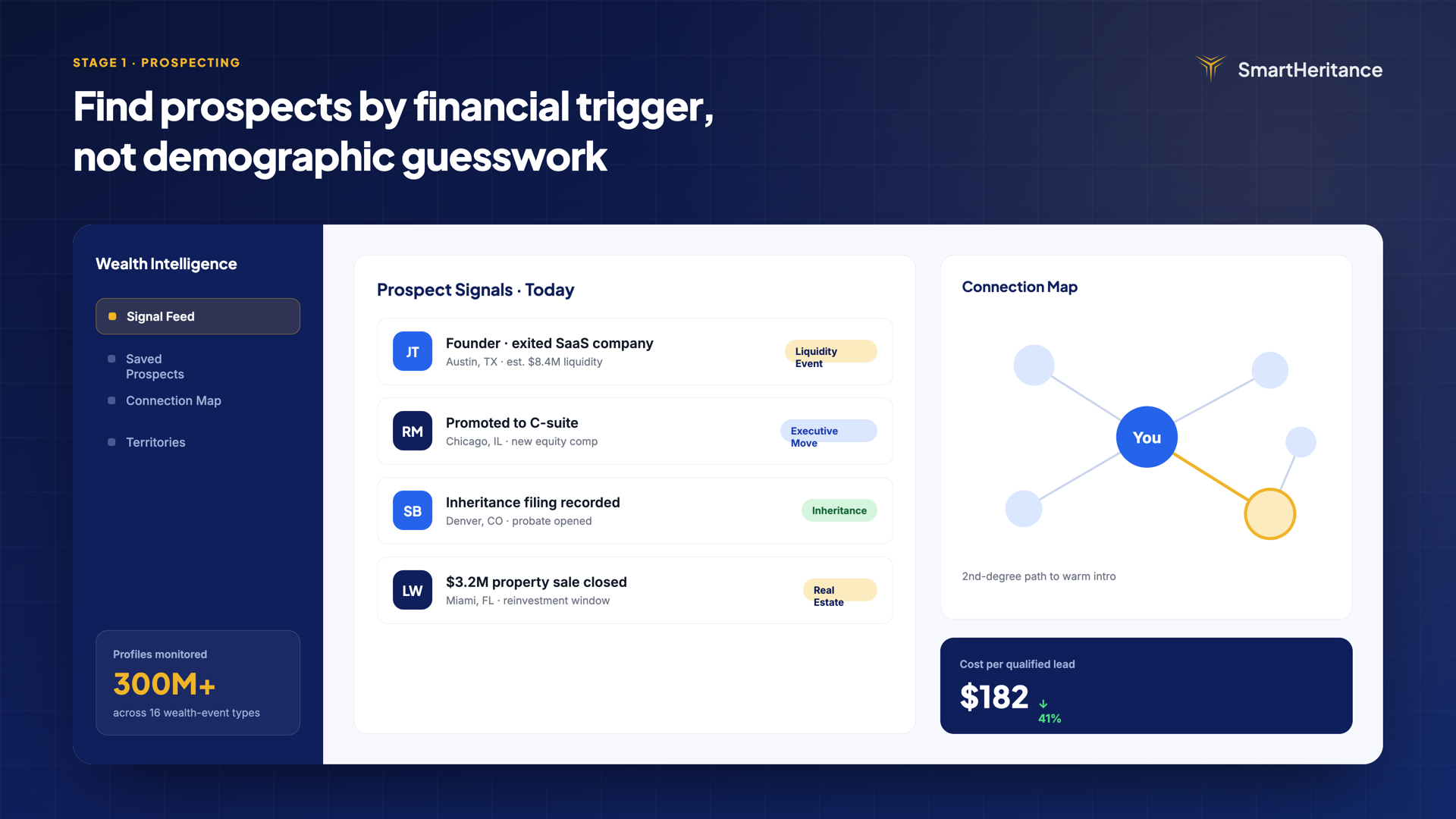
Wealthfeed monitors over 300 million profiles across 16 types of wealth events (liquidity events, executive transitions, real estate transactions, inheritance filings) and surfaces prospects based on financial triggers rather than demographic assumptions. If someone in your target market just sold a company or inherited assets, Wealthfeed flags them before your competitors have any idea it happened.
LinkedIn Sales Navigator remains the most common starting point for advisors building a digital prospecting motion. Its strength is mapping the connections between your existing network and potential prospects, and it integrates with most advisor CRMs so nothing slips through.
SmartAsset SmartAdvisor takes a different approach entirely, generating inbound leads from consumers who are actively searching for financial advice and matching them with advisors based on geography and specialization. The trade-off is that leads get shared with competing advisors, so conversion depends heavily on how fast you follow up.
What matters here: cost per qualified lead (not cost per lead, which is a vanity metric), whether the tool connects to your CRM so follow-up is automatic, and whether it targets your specific client profile or just generates volume you’ll spend hours qualifying yourself.
CRM and Client Relationship Management
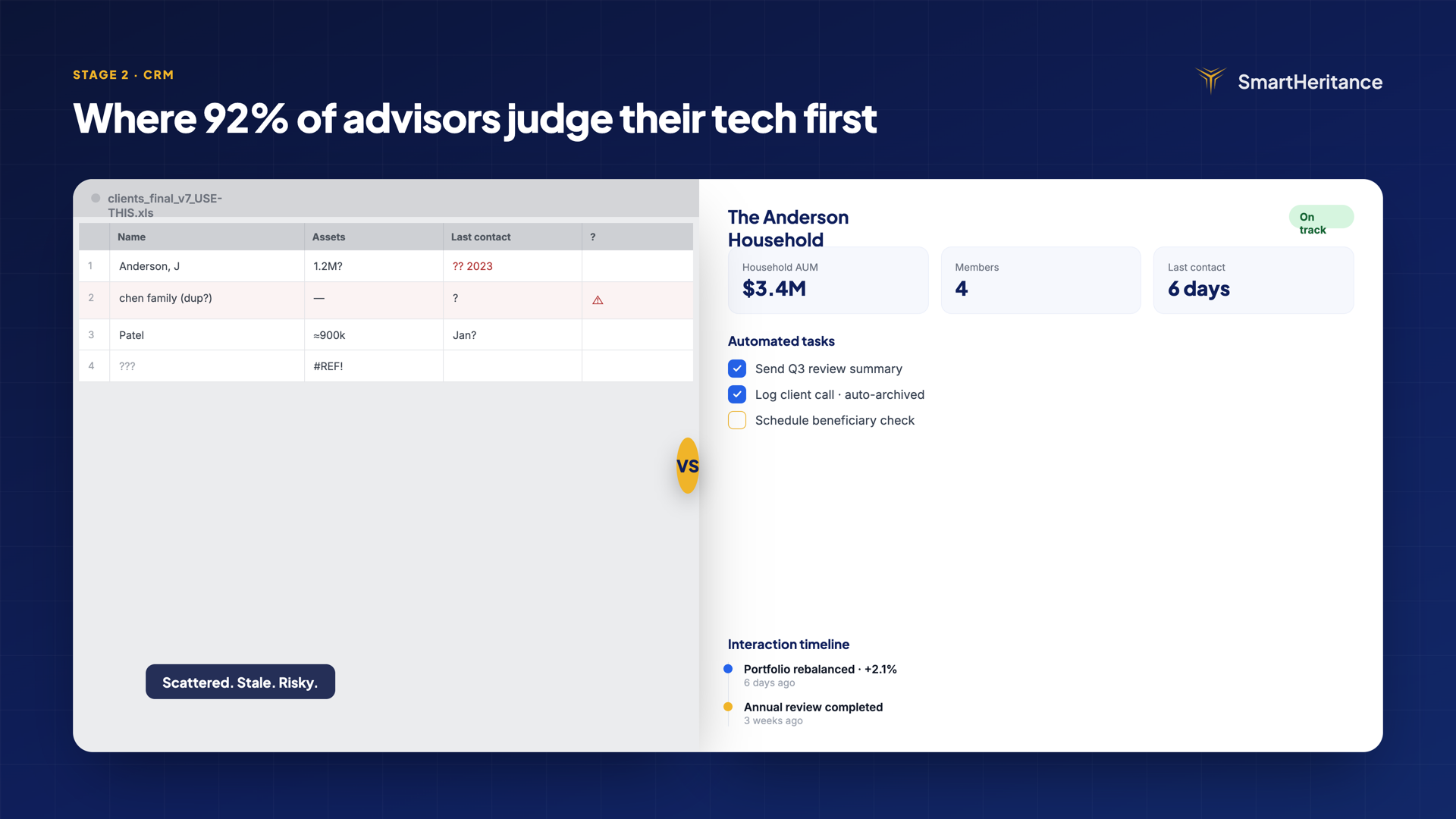
If you’re tracking client relationships in spreadsheets or (worse) your email inbox, the data on what that’s costing you is blunt. Advisor360°’s Connected Wealth Report surveyed 300 advisors and found that 92% would switch firms over bad technology. Not “might consider it.” Would. And 44% already have. Meanwhile, 58% said they lost new business in the past year because of poor tech, and 93% of those who rated their tech as state-of-the-art gained new clients directly from competitors with inferior setups.
CRM is where most of that judgment lands first.
Wealthbox has become the second most-used CRM among RIAs according to the T3 survey, and it deserves the spot. The interface is clean, onboarding is fast, and its 2025 AI meeting notes feature reduced post-meeting admin to something that actually feels manageable instead of a second job. It handles householding, workflow automation, and custodian integrations without the complexity tax of enterprise platforms.
Redtail has been an advisor staple for years, and its staying power isn’t accidental. It integrates with nearly every tool in the advisor ecosystem, compliance logging is baked in (not bolted on), and the mobile app is genuinely usable between meetings. For broker-affiliated advisors who need audit trails that hold up to scrutiny, Redtail is the safe bet.
Salesforce Financial Services Cloud is the enterprise play. Multi-advisor firms, complex team structures, unlimited customization. It requires more setup (and usually a consultant who bills like an attorney), but nothing else matches its flexibility at scale.
What matters here: compliance-friendly interaction logging, integrations with your planning software and custodian, mobile experience you’ll actually use between meetings, and how the system handles householding for family relationships, which is where most generic CRMs fall apart for advisors.
Financial Planning
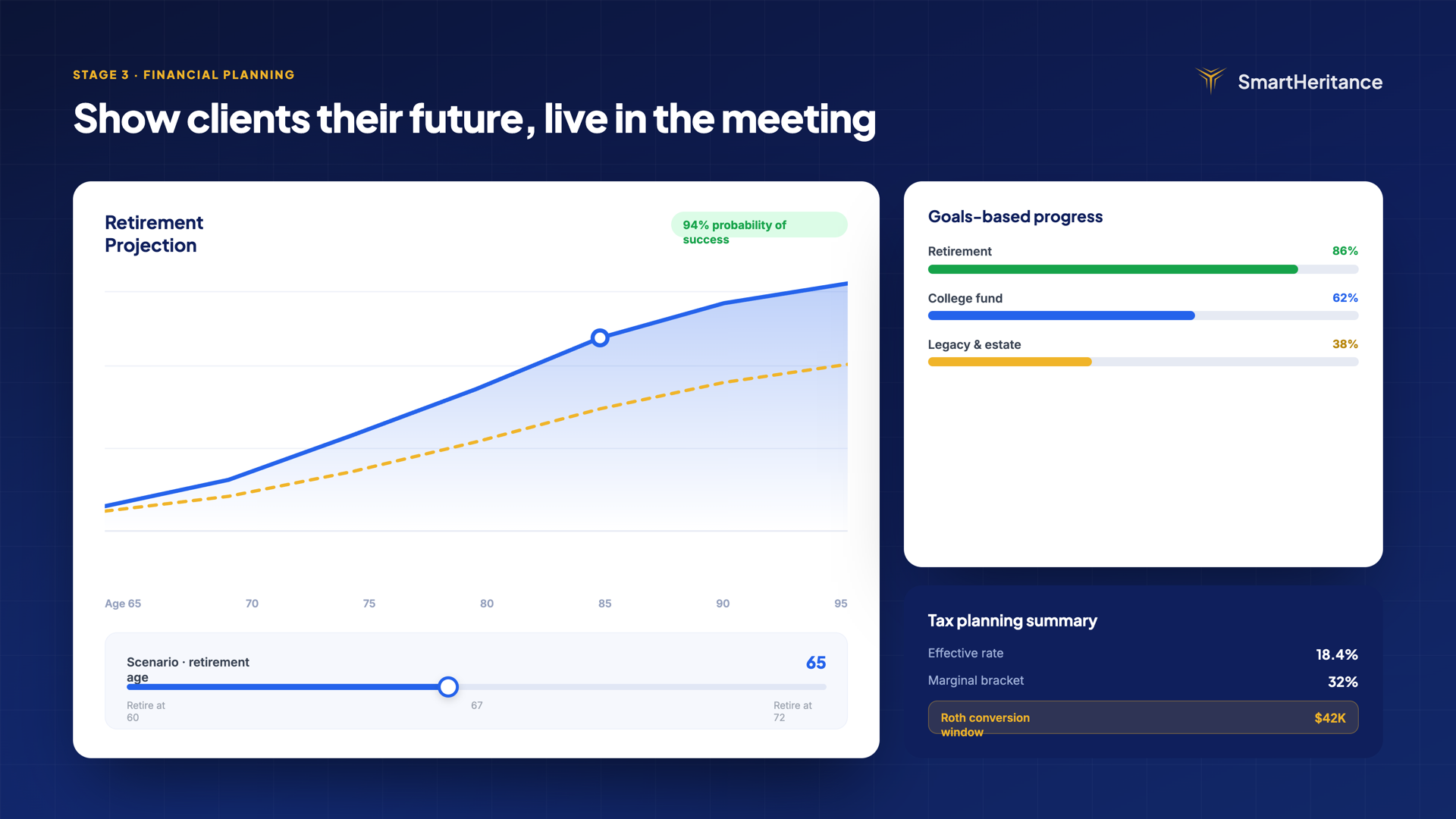
This is where advisory work earns its fee. You’re building the plan, running scenarios, and showing clients what their financial future looks like under different assumptions. Cerulli’s research showed that the tools advisors credit most for operational efficiency were e-signature (65%), CRM (44%), and video conferencing (29%), but planning software is where the quality of the client experience gets defined.
RightCapital has grown quickly among independents, and the client-facing visuals are a big reason. Cash Flow Maps, Snapshot, and Blueprint are strong enough to use in a meeting without needing a separate slide deck. Tax planning is built in, not a third-party add-on you have to configure separately. Integrations with major CRMs and custodians keep data flowing without anyone re-keying numbers.
eMoney Advisor is the established option, and its account aggregation is still the deepest in the category. Clients can link external accounts so the advisor sees the whole picture without chasing quarterly statements. The planning engine handles complex scenarios well, though the learning curve is steeper than newer competitors, which is the kind of trade-off that gets easier to justify the more complex your typical client situation is.
MoneyGuidePro (now part of Envestnet) takes a goals-based approach rather than a cash-flow approach. Some advisors prefer this framing because it keeps the conversation anchored to what clients actually want, not what a spreadsheet says. The trade-off is less granularity in tax planning compared to RightCapital or eMoney.
What matters here: integration with your CRM and portfolio management system (double data entry is where productivity goes to die), quality of client-facing output (your clients will form opinions about your practice based on what they see), and whether the engine handles the complexity level of your typical client.
Portfolio Management and Reporting
Once the plan is built, you need software that manages, rebalances, and reports on the portfolio without eating hours you should be spending with clients.
Orion is the closest thing to a single platform in this category. Portfolio management, performance reporting, trading, compliance, and a client portal all live under one roof. Its integration with Redtail CRM is particularly tight (they’re the same company now), and the Eclipse trading engine handles rebalancing across accounts with the kind of efficiency that makes a real difference when you’re managing 200+ households.
Black Diamond (SS&C) is known for its reporting quality. If your client base is high-net-worth and expects performance reports that look like they came from a private bank, Black Diamond produces that output. Custodian integrations are solid across the major players, and the client portal is designed well enough that clients can actually use it without calling your office.
Tamarac (Envestnet) combines portfolio management, rebalancing, reporting, and CRM in one package. It’s a strong fit for mid-to-large RIAs that want fewer vendors, fewer invoices, and tighter integration between systems. The rebalancing engine is one of the more capable options on the market.
What matters here: custodian integration (Schwab, Fidelity, and Pershing are the three that have to work), rebalancing automation, client portal quality, and whether reporting can be customized to match your firm’s brand without needing a design degree.
Client Communication and Engagement
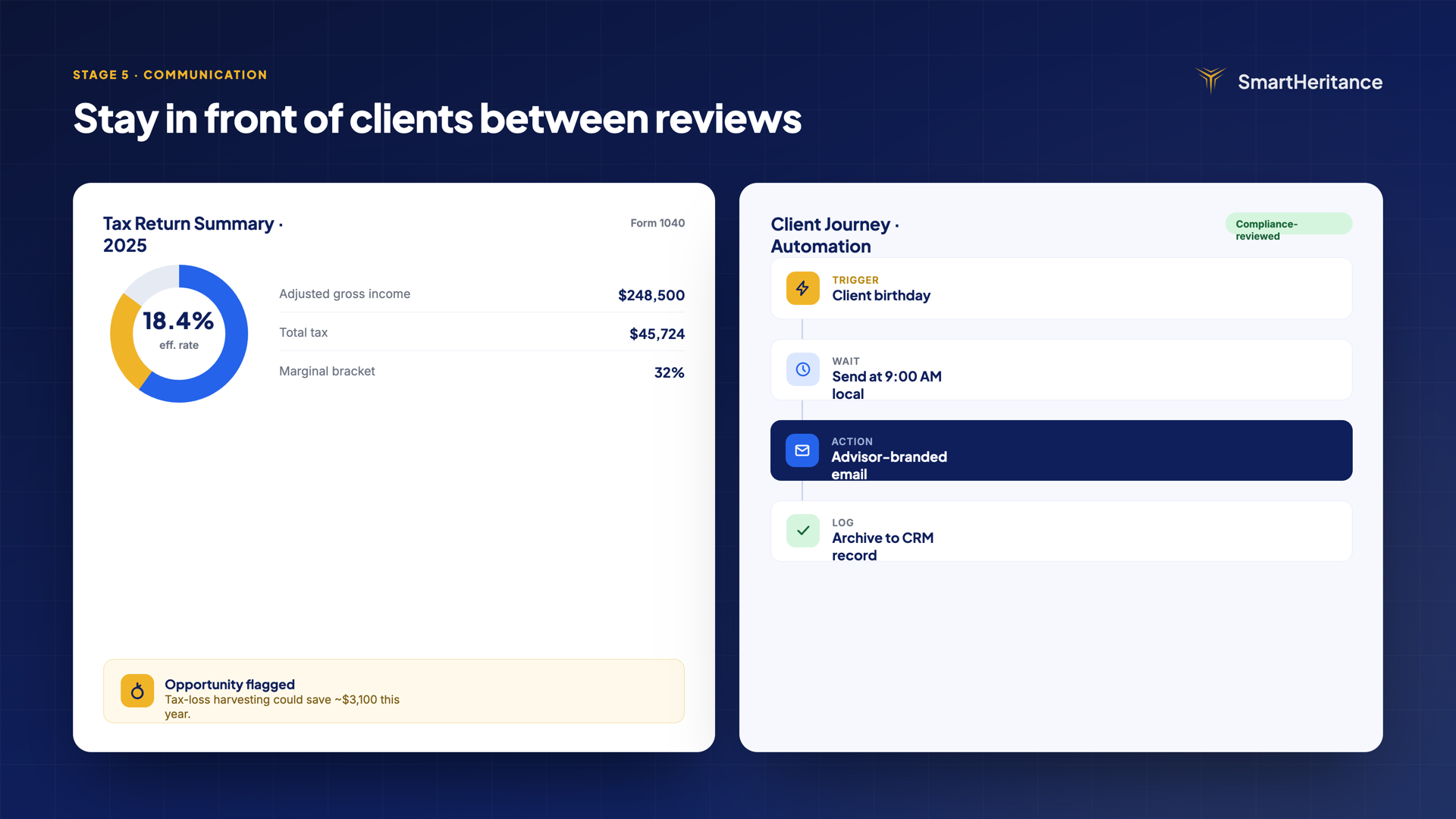
A solid plan means nothing if clients don’t hear from you between annual reviews. The Advisor360° data is useful again here: 93% of advisors with top-rated tech gained clients from competitors who didn’t invest in the experience. A meaningful chunk of that gap is about how (and how often) the advisor communicates.
Holistiplan scans a client’s tax return and generates a visual summary in minutes. It turns a conversation most clients dread into something concrete and actionable. Advisor after advisor cites it as the single tool that generates the most client engagement per dollar spent, and it’s hard to argue with that given how much of the advisory relationship is ultimately about tax.
Snappy Kraken automates marketing and client communication sequences: birthday emails, market commentary, educational drips, onboarding flows. The content library is advisor-specific, not recycled marketing templates with your logo slapped on top, and compliance review is part of the workflow rather than something you remember to do after sending.
Loom may seem like an odd inclusion, but asynchronous video is quietly becoming one of the most effective client retention tools in the stack. Recording a two-minute video walking a client through their quarterly performance feels more personal than a PDF, takes less time than a phone call, and gives the client something to rewatch. Several advisors I’ve spoken to say it reduced their “quick question” call volume by more than half.
What matters here: compliance review capability (every client communication should be archivable), personalization that goes beyond inserting a first name, and whether the tool genuinely saves time or just adds another interface to manage.
Compliance and Documentation
Compliance isn’t optional, penalties for getting it wrong aren’t theoretical, and “good enough” is how firms get fined.
Smarsh handles communication archiving across email, social media, text, and collaboration platforms. It’s the most widely used archiving solution in wealth management, and its search and retrieval capabilities make e-discovery manageable rather than a multi-week emergency when regulators ask for records.
MyComplianceOffice covers personal trading monitoring, gifts and entertainment tracking, outside business activity disclosures, and conflict-of-interest management in one system. It replaces the kind of manual tracking that compliance officers despise and creates audit trails that actually hold up to examination.
RegEd manages licensing, registration, and continuing education requirements. If you’re at a broker-dealer or overseeing a team of advisors, RegEd tracks who’s registered where, what’s expiring when, and which CE requirements are outstanding before they become a problem instead of after.
What matters here: whether the tool matches your regulatory environment (RIA vs. broker-dealer vs. hybrid, because the requirements are different), audit-ready report generation without manual assembly, and integration with your communication and CRM tools so records don’t live in silos.
Estate Planning and Client Continuity
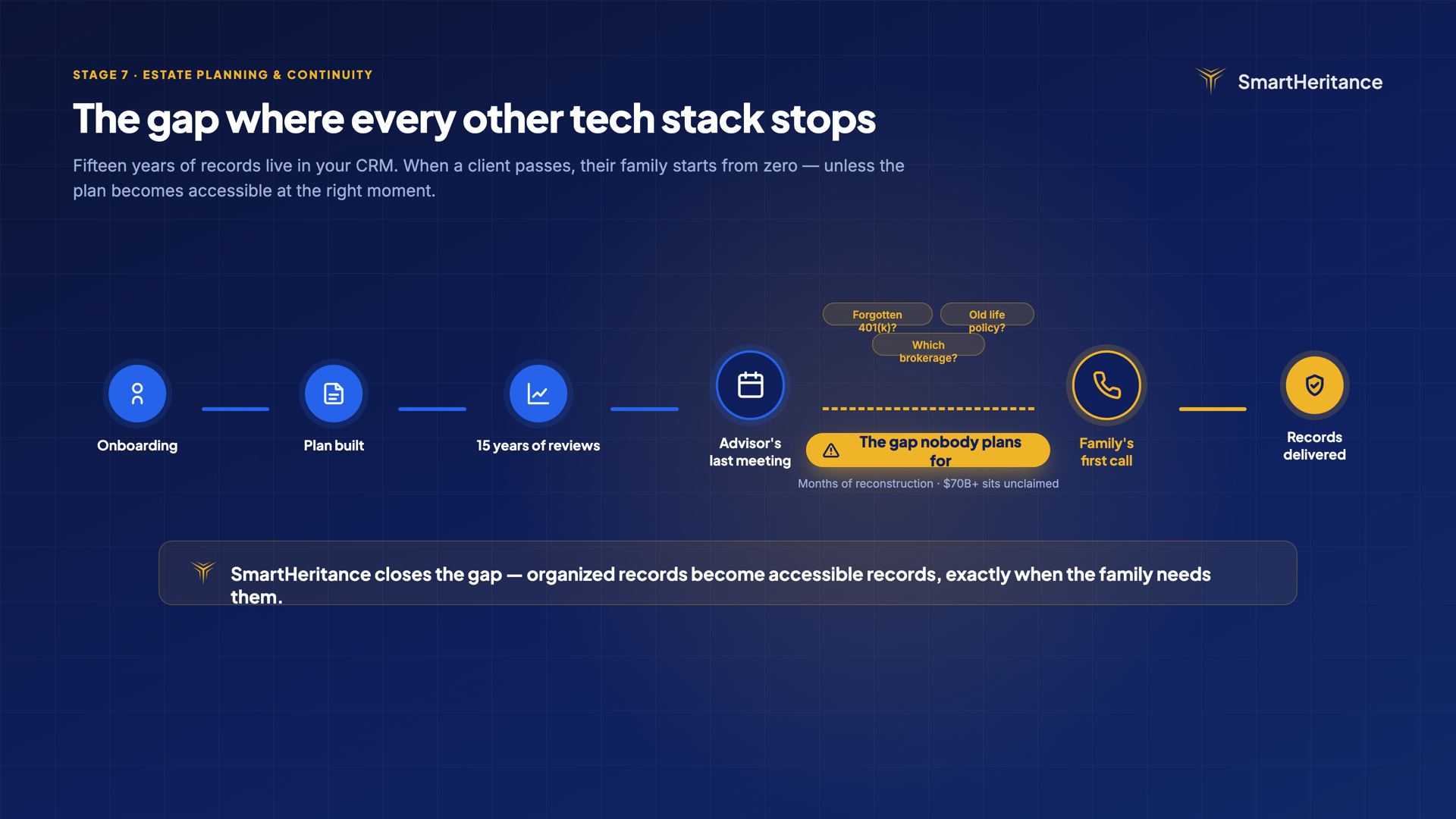
This is where every other tech stack article stops. CRM, planning, portfolio, compliance, communication. Done. As if the advisor’s responsibility ends when the client is alive and actively calling.
It doesn’t. And the gap it leaves is bigger than most advisors realize until a client’s spouse calls to say something has happened.
Here’s the version of that call nobody prepares for. You’ve spent 15 years building a financial plan for a client. You know every account, every beneficiary designation, every insurance policy, every IRA rollover they did four years ago and forgot about. Then the client dies, and the family can’t find half of it. The will names an executor, but it doesn’t list the brokerage account opened after the last estate plan update. The trust references assets that have moved. The retirement accounts from two employers ago? The family doesn’t know they exist. And while you, the advisor, have records in your CRM, the family has no way to get a complete picture of what their loved one actually owned.
The result is months of reconstruction. Families calling institutions they’ve never heard of, trying to prove that an account exists without a policy number to give. Insurance benefits going unclaimed because nobody knew which company held the policy. More than $70 billion in assets sitting in unclaimed property across the US, and a meaningful share of that traces back to exactly this kind of gap.
This isn’t a niche problem. The T3/Inside Information Advisor Software Survey found that estate planning tools have reached 43.28% market penetration among advisors, up from 15.84% just two years prior. And Trust & Will’s 2025 Annual Financial Advisor Report found that 70% of consumers expect estate planning to be part of their advisory relationship, with 37% calling it essential. The demand is already here. The tools are catching up.
Three products serve different parts of this problem, and they’re worth understanding separately.
Wealth.com (formerly Vanilla) helps advisors visualize existing estate plans. Upload a client’s will or trust, and the platform maps how assets flow to beneficiaries, flags gaps, and shows what needs updating. It’s a strong meeting tool that makes abstract legal structures concrete and visual. Its focus is the plan itself, how assets are legally structured and where the documents need work.
Trust & Will provides digital estate document creation. Advisors can give clients a way to create or update wills, trusts, and guardianship designations through a guided experience that takes under 15 minutes. For clients who don’t yet have estate documents at all (and there are more of those than anyone likes to admit), it fills an obvious void.
SmartHeritance solves the problem that sits between having a plan and having a family that can execute on it, the operational gap where organized records become accessible records at exactly the right moment.
Consider what happens in practice. Your client has a will, a trust, and proper beneficiary designations, everything legally sound. But when they pass, their spouse doesn’t know about the Fidelity account, the life insurance policy from a previous employer, or the brokerage account opened after the last estate plan review. The legal documents authorize access to assets the family doesn’t know exist. A Personal Legacy Manager exists to close exactly this gap.
SmartSync, the platform’s patent-pending account discovery tool, connects to the client’s email and scans for correspondence from financial institutions, insurance providers, retirement platforms, and investment services. It surfaces accounts the client may have forgotten about, organizes them into a structured record, and keeps the record current automatically as new accounts appear. Most users discover accounts during their first scan that they hadn’t thought about in years, the kind of forgotten 401(k) or dormant brokerage account that families spend weeks trying to track down after a loss.
The Wellness Check Protocol handles delivery. It monitors user activity in the background. If extended inactivity is detected, the system sends a check-in. If there’s no response, it contacts the designated family members, verifies the situation, and releases the organized record to the right people under the conditions the client defined. The family doesn’t need to know the platform exists ahead of time. The system reaches them.
Everything is stored behind AES-256 encryption with zero-knowledge architecture (meaning SmartHeritance’s own engineering team can’t see what’s stored). The platform is SOC 2 compliant and Google CASA Tier 2 certified.
For advisors, the conversation with clients is straightforward: we’ve spent years building your plan, and this tool makes sure your family can actually use it when they need to. It turns the advisor’s work product into something that survives the transition instead of getting buried under months of reconstruction, which is what happens when a family continuity plan doesn’t exist.
Explore the SmartHeritance advisor partnership program →
Audit Your Stack
Pull up your current tool list and map it against these seven stages. Most advisors will find they’re well covered through Stage 6 and completely exposed at Stage 7. Some will find gaps earlier, a CRM that doesn’t talk to their planning software, or a compliance tool that requires manual report assembly every month.
Schwab’s 2025 Independent Advisor Outlook Study found that 58% of firms plan to upgrade their tech stack in the next three years, and 47% have already started applying AI. The practices that will benefit most from those upgrades aren’t the ones buying the most software. They’re the ones whose tools work together across the full flow, from the first prospect touchpoint to the moment a client’s family needs access to everything the advisor built.
Start where the gap is.
Frequently Asked Questions
How much should a financial advisor spend on technology?
Most independent practices spend between 3% and 5% of revenue on their tech stack. The better question is ROI per tool. A $200/month CRM that saves five hours a week pays for itself immediately. A $500/month platform nobody on your team uses is a recurring reminder that buying software and using software are different things.
Do I need all seven categories to run a successful practice?
Stages 2 through 6 (CRM, planning, portfolio management, communication, compliance) are baseline. Stage 1 (prospecting) depends on whether you grow through referrals, inbound, or outbound. Stage 7 (estate planning and client continuity) is the category growing fastest because clients expect it and advisors who offer it retain more assets across generational transfers.
What’s the biggest technology mistake financial advisors make?
Buying tools that don’t talk to each other. The Advisor360° survey found 38% of advisors cited lack of integration as a top complaint, and 61% cited bad data, which is almost always a downstream effect of disconnected systems. Before adding anything new, confirm it connects to your CRM and your custodian. If it doesn’t, it’ll create more work than it saves.
How is AI changing the financial advisor tech stack?
Faster than most predictions suggested. JD Power’s July 2026 data shows AI adoption among employee advisors nearly doubled in one year (44% to 73%). The first wave has been meeting notes, follow-up automation, and compliance monitoring. The second wave, already underway, is predictive: AI tools that flag which clients are at risk of leaving, which prospects are most likely to convert, and which portfolio adjustments should be made before the client asks.
Should I recommend estate planning tools directly to my clients?
If you want to retain their assets across generations, yes. 70% of consumers expect estate planning to be part of the advisor relationship, and estate planning tools hit 43% market penetration among advisors in the latest T3 survey, up from 16% two years earlier. The advisor who offers something in this category earns a different kind of trust than one who only manages money. For a deeper look at what this involves, the guide on family continuity planning covers the full picture.
References
- Cerulli Associates, “Financial Advisor Practices That Embrace Technology Surge in Productivity and Efficiency” (2024): cerulli.com
- JD Power, 2026 U.S. Financial Advisor Satisfaction Study (July 2026): jdpower.com
- Advisor360°, Connected Wealth Report (January 2024): businesswire.com
- Trust & Will, 2025 Annual Financial Advisor Report: trustandwill.com
- T3/Inside Information Advisor Software Survey, estate planning tool penetration data: yahoo.com/finance
- Schwab, 2025 Independent Advisor Outlook Study: schwab.com
- InvestmentNews, Cerulli heavy-tech performance data (April 2024): investmentnews.com